
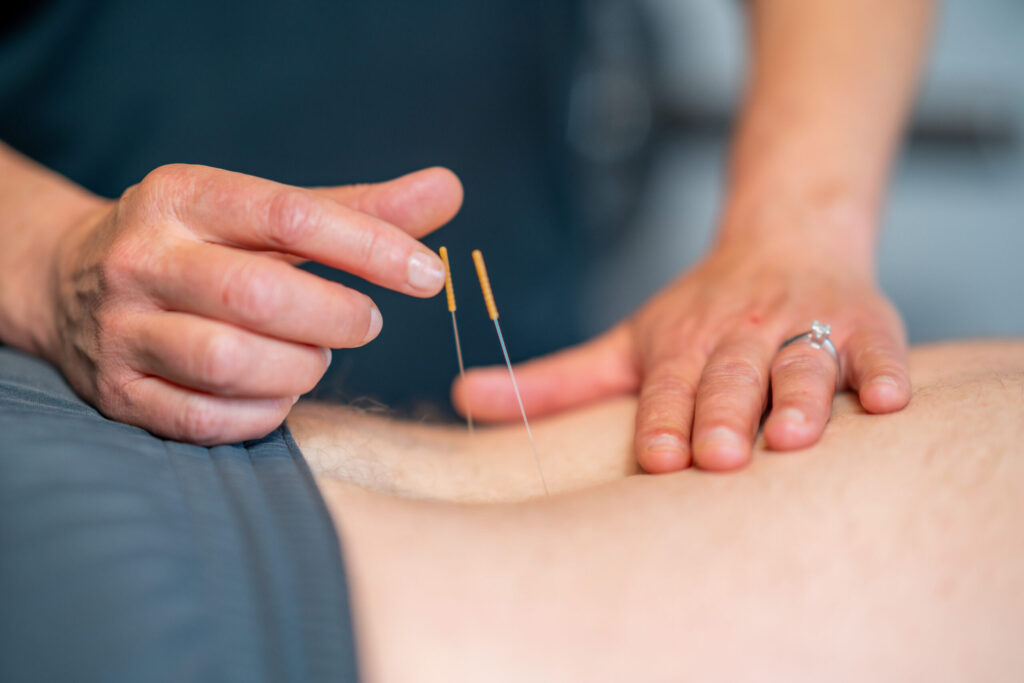
Dry needling is a therapeutic intervention used by physical therapists and other healthcare providers to treat muscle pain, tension, and dysfunction. Dry needling involves inserting thin filament sterile needles directly into the skin and the muscle in areas where knots of tight muscle have formed. These knots are also called trigger points. Dry needling is not an injection. There is no medication or liquid in the needle, hence the term “dry” needling.
Trigger points are localized, tender spots within a muscle that feel like a nodule. Trigger points usually arise from overloading a muscle. Repetitive overuse, acute strain through a quick movement, or lifting a heavy weight can cause muscle overload. Trigger points can even occur from emotional stress or a sustained posture or load. For example, a heavy bag resting on your shoulder for hours can cause trigger points to form. When we use our muscles, the thousands of fibers within the muscle contract (move closer together). After discontinuing muscle activation, the muscle fibers relax (separate out into a resting position). With muscle overload, some of the muscle fibers stay bunched together, creating a trigger point.
Dry needling as a treatment method has increased in popularity in recent years. It is a very effective tool used in physical therapy for pain relief and improved mobility of muscles.
What conditions can dry needling treat?
Dry needling can be used to treat many different acute and chronic pain conditions, including, but not limited to:
Musculoskeletal pain
– Neck pain
– Back pain
– Shoulder pain
– Hip pain
– Knee pain
– Elbow pain
– Wrist pain
– Ankle/foot pain
– TMJ (jaw) pain
Repetitive strain injuries:
– Carpal tunnel syndrome
– Tennis elbow
– Golfer’s elbow
Headaches:
– Migraines
– Tension headaches
– Cervicogenic headaches
Joint and nerve issues:
– Sciatica
– Pinches nerves in neck or low back
– Joint impingement
– Facet joint pain
Muscle issues:
– Trigger points
– Chronic tightness
– Spasms
– Fibromyalgia
Tendinopathies:
– Plantar fasciitis
– Achilles tendonitis
– Rotator cuff injuries
These are just some examples, but essentially any painful or limiting condition due to muscular tightness and trigger points can benefit from dry needling!
Next up, we’ll be discussing all of the benefits and some common possible side effects of dry needling. Stay tuned!
If you would like to be evaluated and learn if dry needling is right for you, or if you have any questions, please call or text us! We’d love to help you. ☎️ (423) 228-8120
Elite Muscle Recovery
See what others are saying: Google Reviews